
We've made personal websites complicated.
A personal website used to be a simple place on the internet with your name on it. A little introduction. Something you had built. Something you had written. Maybe a few links and an email address.
Today, a personal website can look like a startup landing page.
Animated hero sections. Gradients. Testimonials. Carefully crafted personal branding. Multiple calls to action. A portfolio. A newsletter. Social proof.
None of that is necessarily bad.
But some of the most interesting people in technology have taken a very different approach.
Their websites are remarkably simple.
And that's exactly what makes them powerful.
The design gets out of the way, and the person, their work, their ideas, and their interests become the interface.
1. Paul Graham — Let the ideas do the work
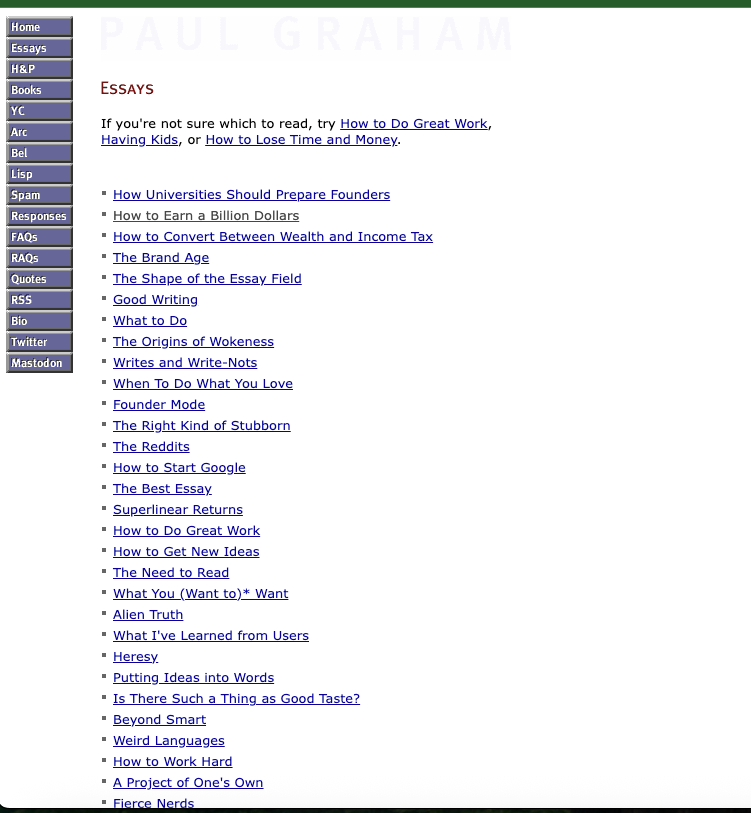
Paul Graham's website might be one of the clearest examples of the philosophy behind this article.
It isn't trying particularly hard to impress you.
There is no elaborate personal-brand experience you need to navigate. Instead, there is an enormous body of writing accumulated over decades. His essays are the product.
And the website is simply the place where they live.
You can browse essays on startups, programming, wealth, education, ambition, writing and a long list of other subjects.
That's an important distinction.
The website doesn't need to convince you that Paul Graham's ideas are worth reading.
The ideas do that themselves.
What to learn
If you have something worth saying, the website doesn't need to shout.
2. Derek Sivers — Your website can be your entire internet
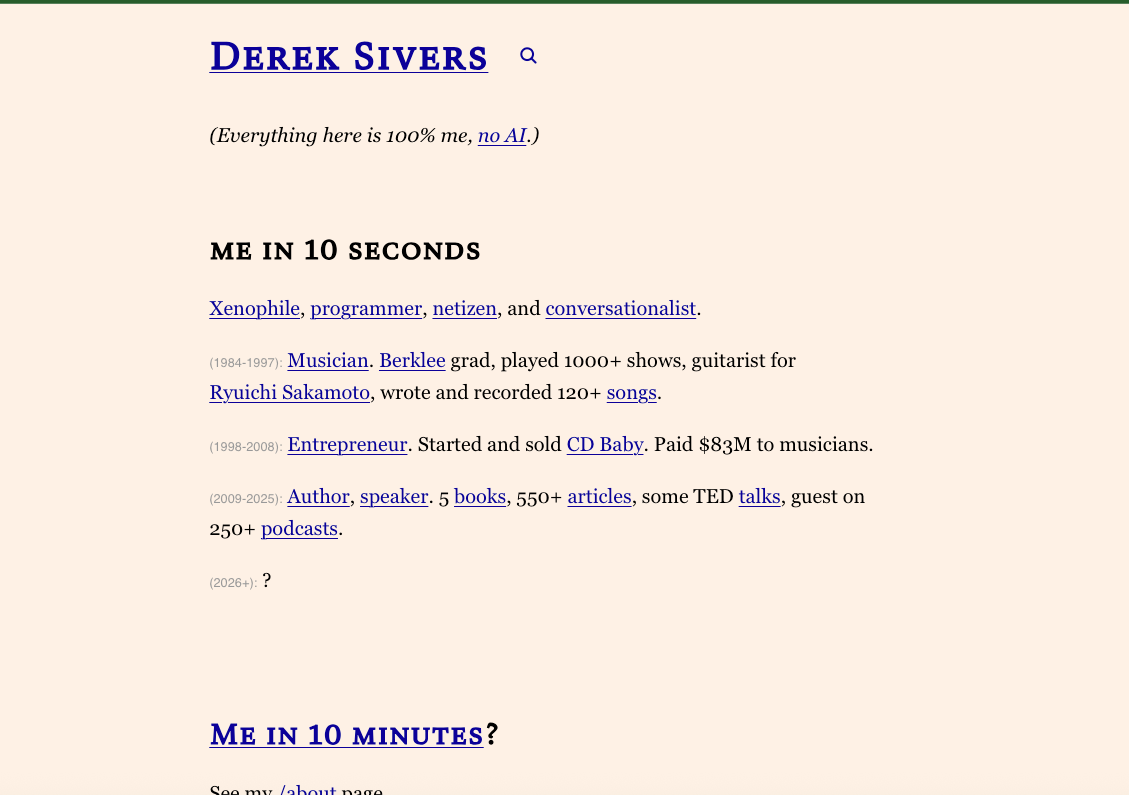
Derek Sivers' website is probably one of the best examples of a personal website becoming a personal archive.
At first glance, it's simple.
But keep exploring and there's an enormous amount there: articles, books, interviews, book notes, projects, photographs, a "Now" page, programming projects and more.
His homepage has an unusually direct description of what the site represents:
Everything I do is here on this site.
And he means it.
The site is not just a portfolio. It is a living archive of his writing, books, conversations, projects and interests.
The simplicity isn't an accident.
It's part of the philosophy.
What to learn
Your personal website doesn't have to be a portfolio.
It can be your personal internet.
3. DHH — Make the website sound like you
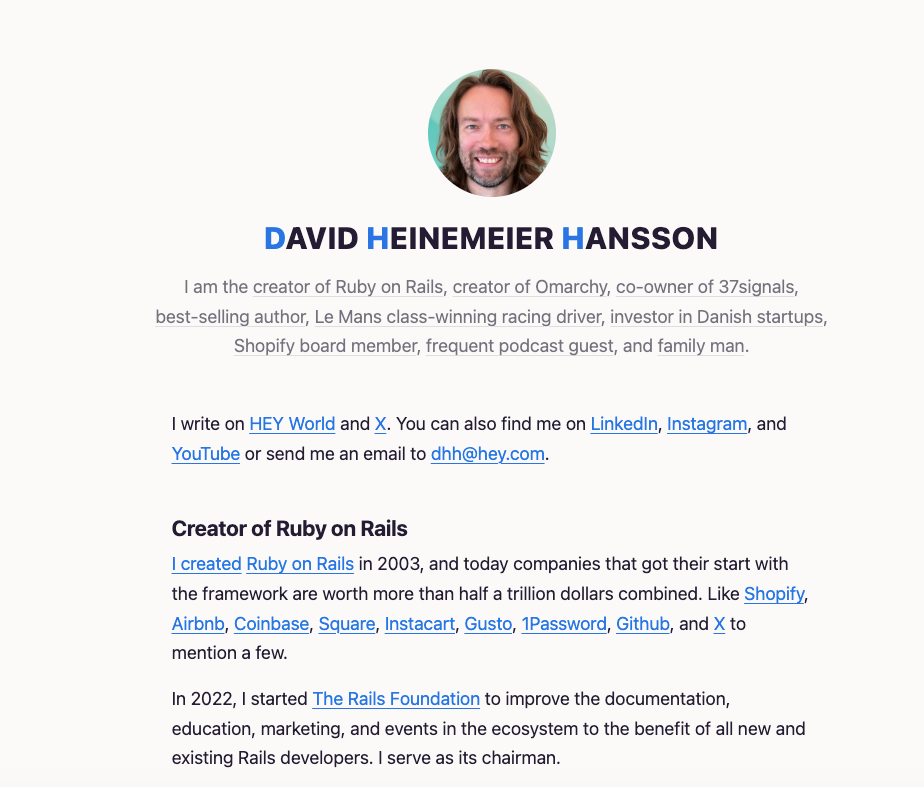
DHH's website doesn't try to separate the person from the work.
It tells you immediately who he is: creator of Ruby on Rails, creator of Omarchy, co-owner of 37signals, author, racing driver, investor and more.
There is no generic corporate biography trying to flatten all of that into a few carefully selected words.
The site feels like a person wrote it.
That's important.
A personal website shouldn't necessarily look like it was designed for a generic "technology executive."
It should look like you.
Your interests. Your opinions. Your work. Even the things that don't fit neatly into your job title.
What to learn
Personality is more memorable than polish.
4. Patrick Collison — Show what you're curious about
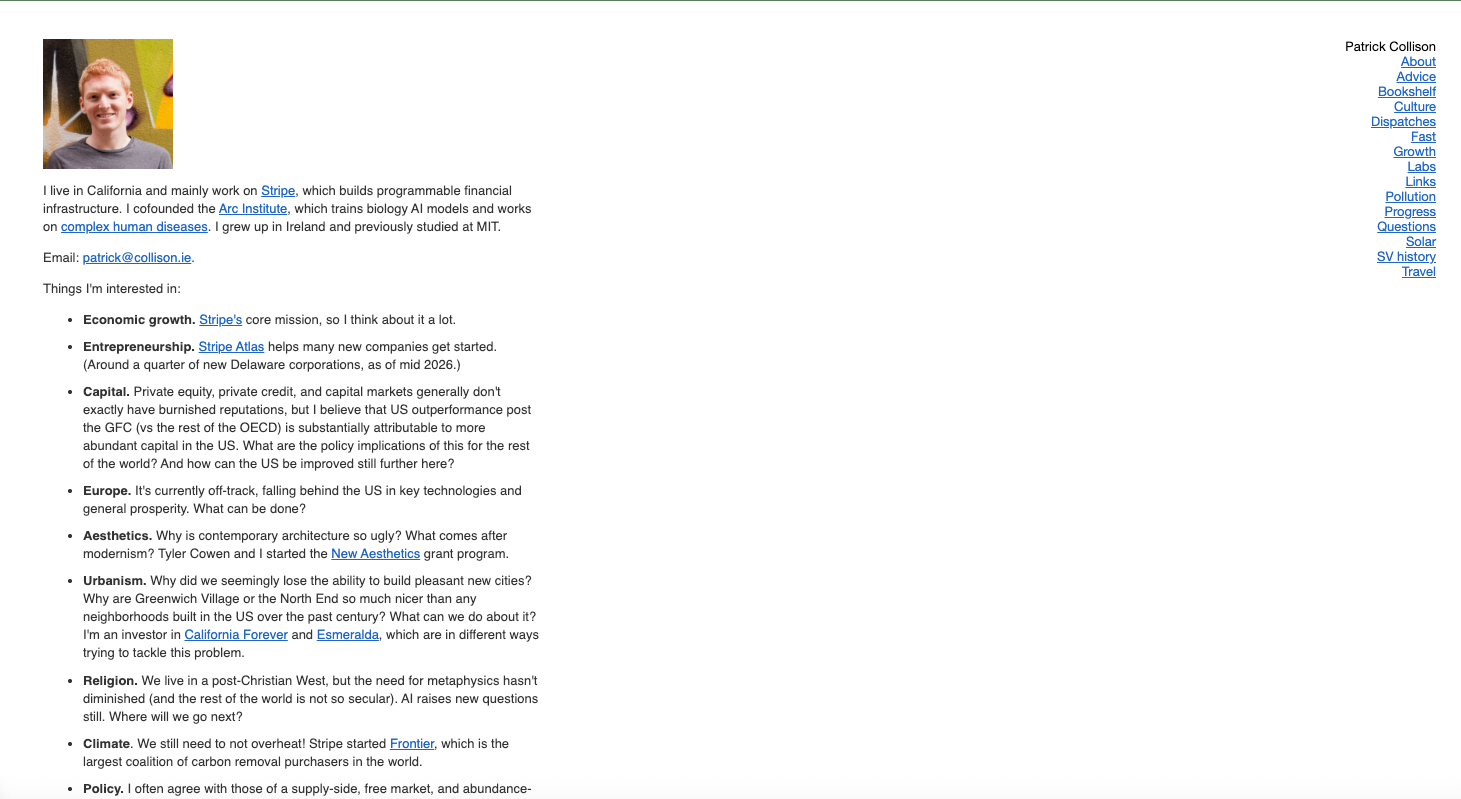
Patrick Collison's website takes another approach.
Instead of presenting a perfectly packaged personal brand, it gives you a map of things he's interested in.
Books.
Culture.
Growth.
Progress.
Questions.
Solar.
Pollution.
Silicon Valley history.
Travel.
And more.
You learn something about Patrick simply by looking at what he chooses to collect, explore and think about.
That's a powerful use of a personal website.
You don't always have to tell people who you are.
Show them what you pay attention to.
A résumé tells people where you've worked.
A website like this tells them how you think.
What to learn
Curiosity can be a better personal brand than a résumé.
5. Naval Ravikant — Build an archive of ideas
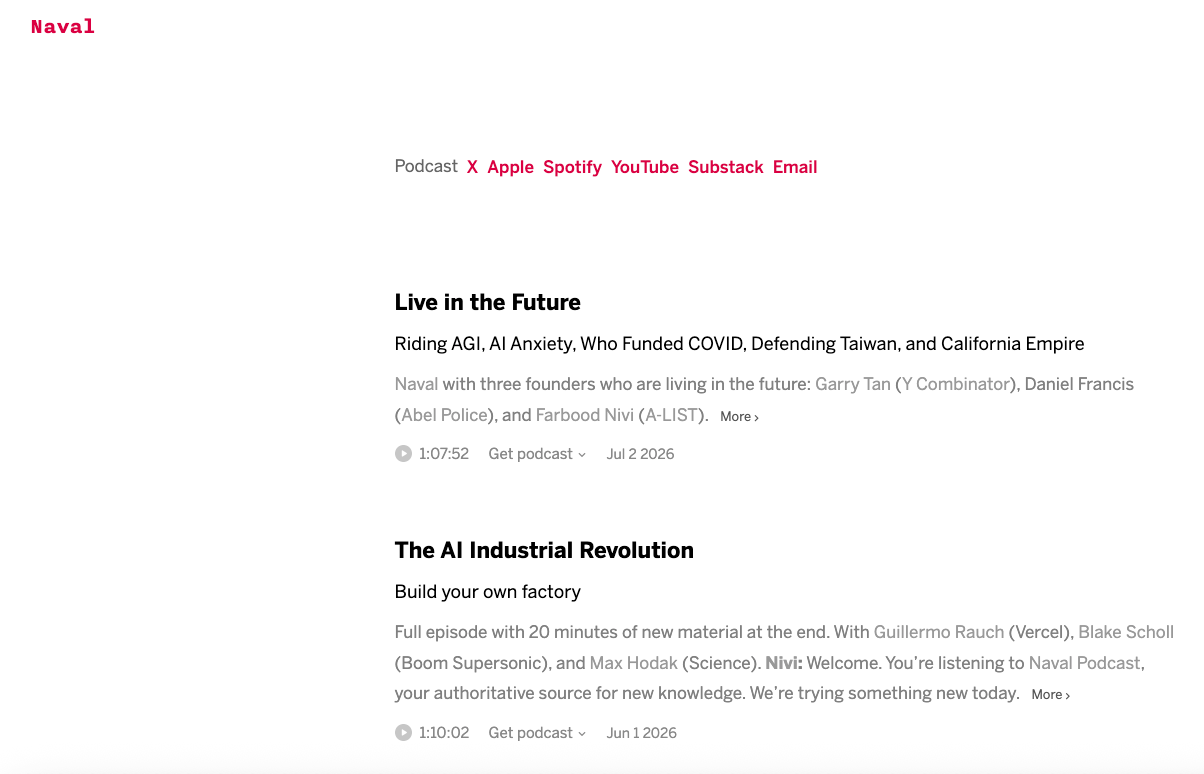
Naval's website is straightforward: an archive of his writing and conversations, alongside his podcast and links to the places where his work lives.
There is something valuable about this model.
A personal website doesn't have to be a portfolio of everything you've ever done.
It can be a library of the things you want to be remembered for.
For Naval, that means ideas, essays, conversations and podcasts.
The website becomes less about introducing Naval and more about giving people a way into his thinking.
What to learn
Your website can become an archive of your thinking.
6. Matt Mullenweg — Keep publishing
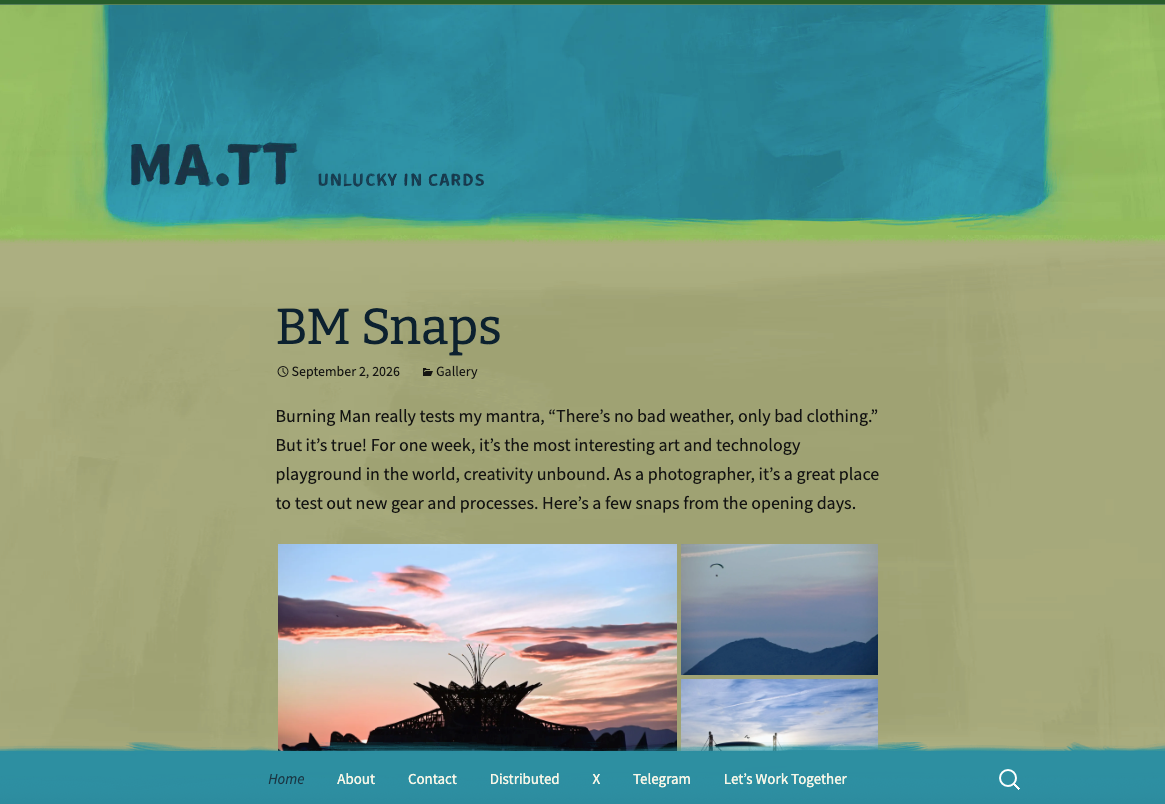
Matt Mullenweg's website feels much more like an actual blog than a conventional founder website.
And that's a good thing.
It is a place where he continues to write about WordPress, technology, photography, travel, personal experiences and whatever else happens to occupy his attention.
The important part isn't the visual design.
It's that the site is alive.
A personal website doesn't have to be finished.
In fact, it probably shouldn't be.
The best personal websites evolve as their owners evolve.
What to learn
A living website is more interesting than a perfect website.
7. Bryan Johnson — One strong idea can organize everything
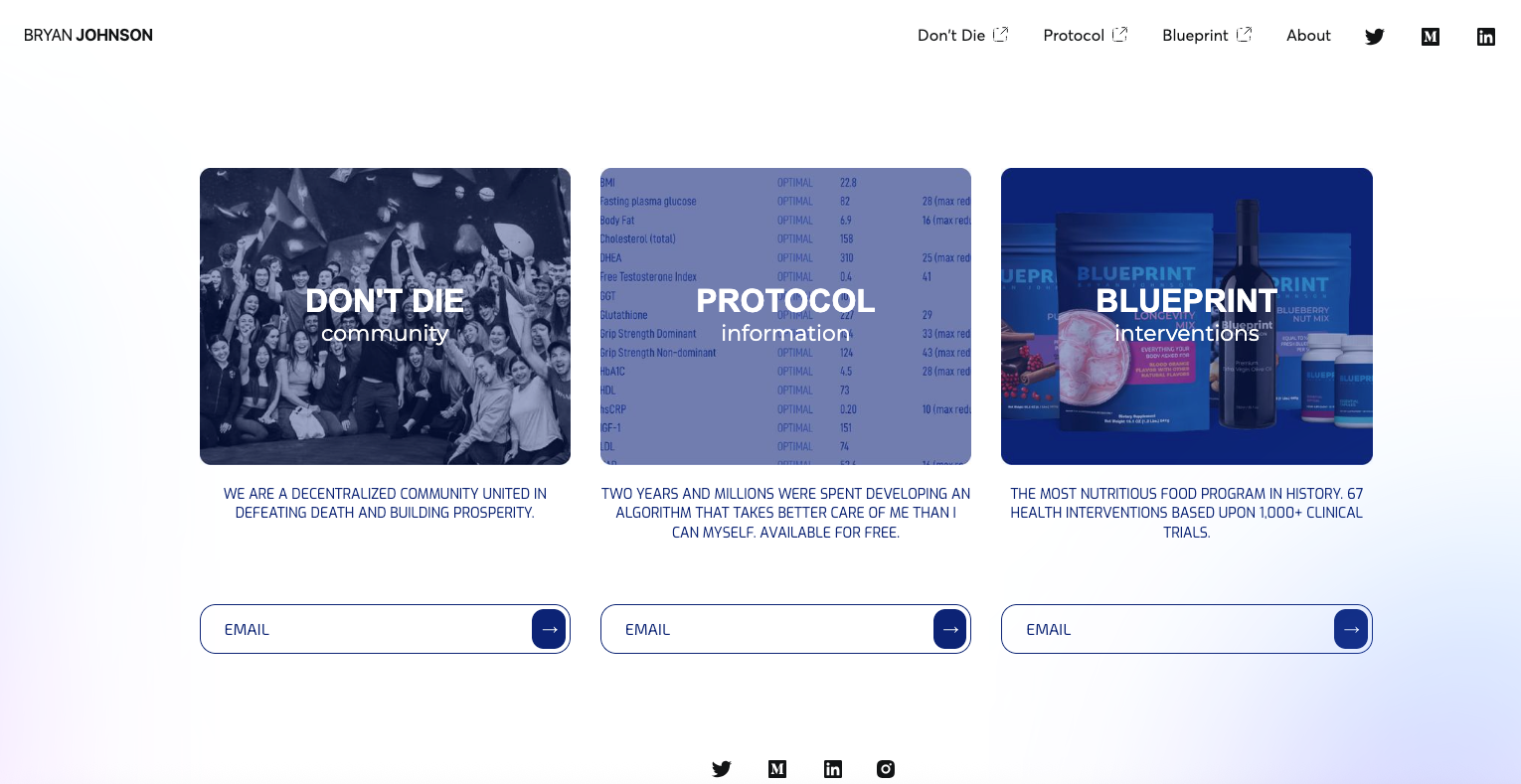
Bryan Johnson's website demonstrates another version of simplicity.
His online presence is organized around a very clear idea: Don't Die.
From there, the site connects his philosophy, health protocols, Blueprint and broader mission.
You don't have to spend much time wondering what the website is about.
That's powerful.
Simplicity doesn't necessarily mean having very little content.
It can mean having one central idea that connects everything together.
For one person, that might be longevity.
For another, it might be open source.
For another, it might be startups, writing, engineering, investing or photography.
What to learn
Clarity is a form of simplicity.
8. Pieter Levels — Let the work become the résumé
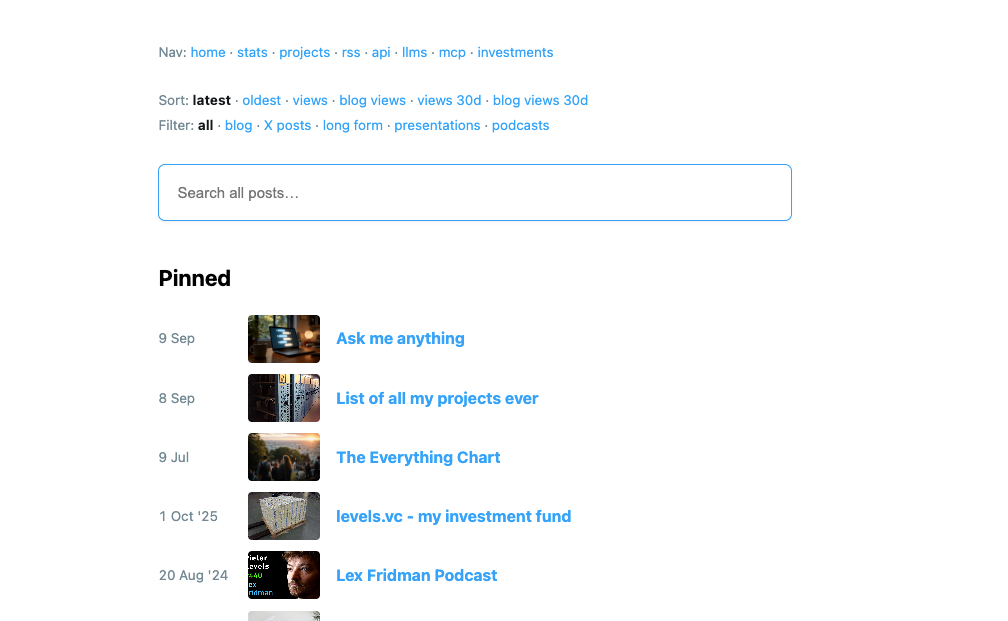
Pieter Levels' website might be the most fitting person to end this list with.
His website is closely connected to the things he actually builds.
His projects page is essentially a record of the things he's built — including successful projects, failed projects and experiments.
That last part is particularly interesting.
Most résumés are designed to show only the successes.
A project archive can show the failures too.
That's much closer to what building actually looks like.
The website doesn't need to tell you that he's a builder.
The projects tell you.
What to learn
You don't have to tell people you're a builder when you can show them what you've built.
The website is simple. The person isn't.
These eight websites aren't identical.
Some are almost startlingly plain.
Some contain years — or decades — of writing.
Some are archives.
Some are blogs.
Some are collections of interests.
Some are essentially living résumés.
But they have something important in common:
The design doesn't get in the way of the message.
And perhaps that's the bigger lesson.
We've become very good at designing websites that look impressive.
But a personal website doesn't have to impress everyone.
It needs to represent you.
Your writing.
Your work.
Your projects.
Your interests.
Your opinions.
Your curiosity.
Your journey.
And this isn't something reserved for technology leaders.
You don't need to be a famous founder to have a personal website.
You don't need millions of followers.
You don't need to have written a book or built a billion-dollar company.
You don't even need to know exactly what your website will become.
Everyone deserves a personal website.
Because the internet shouldn't only be a collection of company pages and social-media profiles.
It should also contain small corners of the internet that belong to individuals.
A place you control.
A place where your work can accumulate.
A place that can still be yours ten years from now.
And you don't need to make it complicated.
Start with a name.
Add what you're working on.
Write something.
Link to something you built.
Tell people what you're curious about.
Then let it grow.
Keep the design simple. Make the message matter.
Build your own corner of the internet
If you want a simple place to start, HuntYourTribe Profiles lets you create your own corner of the internet without building everything from scratch.